Saturday, 28 March 2015

Lightweight Models & Cost-Effective Scalability #4

According to O’Reilly, the business saying of “get big fast” has now become “small is the new big”. As all these blogs suggest, ‘lightweight models and cost-effective scalability’ is another essential concept of Web 2.0 business models. Thus said, for a company to do more with less, changes in cost, reusability, process and strategy would need to be applied. Adopting scalable, cost-effective business models whilst delivering products to the market faster and cheaper would create benefits which include:
  • Faster time to market
  • Faster return on investment
  • Reduced risk of project and product failure
  • Greater adaptability
Pinterest is one of the many businesses which will be shown to "do more with less". So from my other blog, I've mentioned that Pinterest is a content sharing services where users are able to link sources of news, images, videos and anything of interest on their board. It was launched in 2010 and currently has 300+ employees looking after more then 48.7 million users! To be who they are today, these practices include:

1) Scale with demand

In 2012, Pingdom.com did an analysis of how many employees to users were there across the main social tools at the time. 


From this image above, it showed that Pinterest was beating other social tools and was regarded as being the most efficient company in social media at the time. As Pinterest grew, it was necessary for them to come up with more features to keep their users interested. As a result, they released a function called secrete boards which only allowed the user and invited users to view. Initially they only allowed up to three secret boards per user but due to popular demand, they allowed users to have an unlimited amount. What this shows is that Pinterest is the true definition of "do more with less".

2) Sydnicate business models

This practice is about building on top of components from others. This practically means having part of your site seen on other sites whilst allowing others to to place ads on your own. In Pinterest's case, this meant creating their own plug-in so users could easily share any pages they came upon with a click of the button.


Another way of seeing this is that Pinterest does not place random ads on their site, but allow businesses to create an account with them and be part of the community. The whole point of Pinterest is to show what you are interested in or advertise other links or posts. The same goes for businesses, Pinterest allows partnerships and provides business accounts with different functions. Since Pinterest is so widely used, users can generate revenue by adding only a few links to Pinterest's site.

5) Scale your pricing and revenue models & Pricing and revenue align with the core attributes and patterns of Web 2.0

Pinterest is a free service and is easy to adopt and apply using a few plug-ins and links. Since Pinterest is a software-as-a-service, it provides constant updates and allows for user feedback. So since Pinterest is a free service and is easy to use, businesses and users have no reason to not use it. This is beneficial to Pinterest as it will increase their user base and therefore create revenue in other aspects.

Some users may be deterred from using Pinterest since it may not produce traffic to their personal sites. For example, when people Google a certain object, the first result may be of the object on Pinterest's website. Once users see the item on Pinterest, that may be the end of the search for the user.

6) Market virally

Pinterest, just like Facebook, Google Plus, has a widget which may be found on some site for users to quickly access the sites Pinterest account or to save the post on their own Pinterest account.

In comparison to Linkedin when it comes to providing the best practices, Pinterest does not deter their users with upgrades which require payment. Everything is free to use with Pinterest which is why they have such a huge large user base. However, what Linkedin has that Pinterest doesn't, is the ability to connect with users on a personal level. It is better to create traffic to ones personal sites and profiles then to create traffic ones Pinterest account where the user may not benefit from the traffic.

There are more practices that Pinterest apply which make it such a highly used service. But what we can take away from this is that Pinterest is a lightweight model and it is very cost-effective since majority of the service is free for users.

Thanks for reading! Let me know what you think makes Pinterest such a valued service in the comments below.

Saturday, 21 March 2015

Perpetual Beta #3

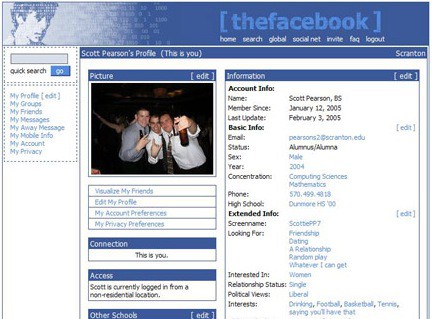
Do you remember what Facebook used to look like? Did you know it's been 11 years since it first came out? It originally looked like this...


But as time went on, Facebook grew and constantly made changes as more people recognized it as a social tool and an ongoing service. These constant updates and new features created an engaging experience for the users even though some of these changes were for testing purposes. This is otherwise known as 'perpetual beta'. To create ongoing updates as the incomplete service continues to develop.


What Facebook does is make their users feel like they are the first to be a part of their newest features. One of the things they do is that they do not ask you to update anything upon any of their changes. This may feel like a small component but it makes the users feel as if it’s the real deal for the site. Upon adding new features, Facebook also provides instructions and tips to better understand the changes. On top of that, Facebook is able to monitor who and how many people uses these features. This allows developers to better understand how impactful a feature is.


They also do not make drastic changes they don’t want to overwhelm their users. So they slowly brought out features like Facebook messenger and video. From this, they were able to monitor the feedback or conversations on the given feature. All they need to do is track keywords in conversations and get a general idea of what people may think about it. Sure this may be breaking some privacy laws, but Facebook can gain much needed information to better understand their own product.

On a programming side, Facebook uses PHP to boost compiling performance, Linux since it is open source and to boost network throughput, MySQL logic storage on web servers and many more. The more tools that can be used with Facebook, the faster updates and new developments can be released for feedback. This is really appealing since Facebook is so heavily used, it opens up and allows a number of different languages to be applied.

When you compare Facebook to a site like Myspace, they both continued to grow and continually introduced new features to keep up with their user base. However, Myspace failed to listen to their users and according to certain posts, politics and new management 
ruined Myspace's reputation. Facebook soon became the norm of social tools. 


Thanks for reading my post! Let me know what feature you really liked about Facebook which they later removed or visa versa.


Sunday, 15 March 2015

Rich User Experiences #2

The internet once began with websites with simple designs which included an image, a bunch of buttons with hyperlinks and possibly an animated image. But as time went on, the internet grew and the users grew bored of these plain sites. For this reason, the internet transformed in a way which gave sites the 'Wow!' factor to impress their users in hope that they will be loyal to the brand. They do this by adding unique transitions, simple effects or by making the site more interactive. 


A site which offers a rich user experience would be...
The reason why Dropbox provides a rich user experience is because it follows the correct practices and these include: (These headings can be found here)

1)  Combine the best of desktop & online experiences. 
Dropbox allows users connect to their cloud storage through any device. Users are able to install Dropbox onto their main computers and any file that is moved to that folder automatically gets synced up to the cloud. Even when the user is offline, they are able to transfer files to that folder and as soon as they reconnect to the internet, the files will be uploaded. The same goes for mobile devices. As soon as a picture is taken, it is automatically uploaded to Dropbox where all devices are able to view the image as soon as it is completed.

2)  Usability and simplicity first.
Dropbox has a very simple colour scheme, blue and white. Everything on their website is very clear and is just a drag-and-drop process when it comes to storing files. For users, this means it is easy to use and are not overwhelmed of the use of cloud storage.

3)  Match the technology usage to the requirements.
Dropbox consists of a number of cloud-based services. They use a number of programs including: Python and the toolkits wxWidgets and Cocoa, Go and CoffeeScript for the browser.

4)  Search over structure.
Many websites now use Dropbox as a means to upload files to their own site. Since over 300 million people use Dropbox, it only makes sense that other sites incorporate Dropbox's API for uploading.

5)  Preserve content addressability.
Everything is stored on the cloud. If files were accidentally removed, users are still able to backtrack and restore their Dropbox to a previous format where the files still exist. So files are never truly lost. For users, this removes the worry of accidental file deletion since there is always support available to help backtrack and return files.

6)  Deep, adaptive personalization


Considering this is a cloud service, files uploaded to Dropbox are all dependent on the user so there wouldn't be any type of recommendations. However, as an incentive, Dropbox does give users a certain amount of space depending on what actions were taken. Recently, I was given a bonus 2 gigs of data for using their email service. On top of that, I asked my friend to use the same Dropbox account as I and she lives in America. Altogether, Dropbox gave me a total 54.8 gigs for 2 years instead of me having to pay money for extra space.


When comparing Dropbox to a similar site for example Google Drive, the experience may differ depending on the user. Google Drive has a better browser and interface and it looks much more empowering than Dropbox's basic look. Not saying that Dropbox's browser looks terrible, it’s just a difference that some users may notice. However, Google Drive does not have a feature to automatically upload photos or files directly from the phone directly in their service. This may not seem like much but you could lose/break your phone at any point and all those important photos you've been taking will be lost forever. Dropbox does have this feature and this is most likely the clearest comparison between the two competitors.
Dropbox and cloud servicing is continually expanding in different ways as more users realize its necessity.  A way Dropbox could improve itself is creating an offline Dropbox where users are able to constantly upload their files to the cloud without the use of internet. But that's something totally different... Realistically, I think they should add a bit more to their browser's interface. Just to add little bit more fun.

So who do you think is better: Dropbox or Google Drive and why?


Thank you!


Saturday, 7 March 2015

Data Is The Next "Intel Inside" #A1


The story goes that between 1981 and the mid 2000s, Intel, a company that develops computing devices, began a campaign to separate themselves from other competitors. They started a campaign due to the fact their hardware was unrecognized because everyone assumed what was inside the computer was created by the devices brand. To differentiate themselves, they branded all of their devices stating that it would be better than the competitors and paid companies to advertise this message.

However, hardware is not the most important thing today. Instead, it is the data that is stored or received from these devices or services which are seen as valuable assets to organisations as it helps better understand their user base. The reason being is that these databases hold information about the user and common trends which can tell an organisation if they are growing in a positive or negative way. Not all organisations will have the data available, like Facebook does due to their user base which is why it holds such value.

So a good example of a social tool with a well recognized user base is none other than...


Pinterest is a website focused on users making a profile and showing their interesting in certain activities or sites by bookmarking other sites or other pinterests as individual images. The reason why Pinterest has such a wide user base is that it allows its users to make a post and then brings together other users with similar interests. The data found inside Pinterest is enhanced by the use of comments, likes, and by how many people have the same post/image pinned on their profile. Majority of posts will have the users description of the post linking it to the website the post was found. This database is further enhanced by the search bar and the tags that connect to each post. By typing in key words, a post can be easily found by typing specific tags.

The site also melds with other social tools making it a one click connection. On top of that, the site allows you to create secret posts that only you can manage and see while no other user can view creating a secure environment for their interests. What this means for Pinterest is that they are able to see what kind of data is seen by a user and therefore can make recommended posts which the user may be interested in. Another fact about Pinterest's terms and services is that once something is uploaded to Pinterest, it may continue to stay up there even though your account is closed and it can be copied and pinned on other user accounts.

A bad thing which has emerged from the use of Pinterest is that it may possibly alter a user’s online identity. According to a post, a user was trying to advertise their own site using their Pinterest profile; however, it removed the traffic going to their own website as users did not progress to the link included. Although this is not technically Pinterest's fault, it has a negative impact on those who do try to make a name for themselves in the online world.


If we were to compare Pinterest to a similar site for example 'Dribbble', the difference would be their user base. Dribbble limits the number of people who can actually post. Thus, it prevents anyone from creating an account and posting posts they find in comparison to Pinterest. This means that less people would use Dribbble as they limit what their users can do where Pinterest does not.

So we can see that Pinterest accumulates data which may be considered a valuable asset to them and possibly other organisations for research. From the image above, there is value in all sorts of data gathered from the social tool including which countries use the tool the most or to track upcoming trends.


Wednesday, 24 September 2014

Misuse of Social Technology - Week 9 Activty

Organisations are always trying to make the most of social technologies these days and generally hey get the job done right. But if there are good things, there also bad things that can come from these tools. So which organisation 'misused' social technology?

Amy's Baking Company Bakery Boutique & Bistro is an upscale full service Retail Patisserie as well as a full service European Bistro & Bar.


Restaurant owners Samy and Amy Bouzaglo were featured on an episode of Gordon Ramsey's Kitchen Nightmares. They were soon dumped by Ramsey after being too difficult to work with. After airing, they received negative feedback through social media which appeared to had struck a nerve in the couple. They replied by using Facebook as a means to defend themselves against all the hateful comments. However, many of us understand that there are certain ways to deal with negative comments. The Bouzaglo's ended up pouring more oil on the fire as the comments kept piling on top of each other. It got to the point where the pair were uploading posts full of foul language and threats whilst trying to defend each other. Here is a link to their Facebook page.

From this,


To this,


Receiving bad feedback from a well known chef on national television is already bad for business. But to be provoked by hateful comments and to search and reply to these post with just as negative language only makes things worse. The couple then tried to defend themselves again by saying that they were hacked which only fueled readers to argue their point even further. The outburst on Facebook resulted in the downfall of the Bouzaglo's reputation and thus reduce the number of customers they would have. Reputation and ratings are the most important things to a restaurant. Having bad reputation on sites that are there to get your business brand out in the public and poor rating is the last thing any restaurant owner wants.

It is hard to say how much they actually lost but receiving a negative review would have only led  a decrease in customers. This could mean increased expenses via employee wages, produce and lane as they would not be hitting weekly or monthly targets. 

Restaurant owners like this can avoid misusing social technology by simply not using social technology as a means to vent out. The posts can also be removed from the main page to avoid further commenting and communication between the owners and users. Professionalism should always be shown. Education is another way to avoid misuse of social technology as it provides awareness and experience for different situations [1].

So has there ever been time where you regretted using social technology? Thanks for reading. Don't forget to head to my profile if you have any questions.

[1] Dundas Lawyers, "Legal risks of social networking for business". [Online]. Available: http://www.dundaslawyers.com.au/legal-risks-of-social-networking-for-business/. [Accessed: September 9, 2014]

Wednesday, 17 September 2014

Old Spice Campaign ROI - Week 8 Activity

Look at your keyboard. Now back to the screen. Now back to the keyboard. Now back to the screen. Fortunately, everyone knows where this is going. Look down. Now back up. Where are you? You are still in the same place about to read a blog about Old Spice's ROI (Return of Interest).

For those who are unsure of what Old Spice is, it is a brand of male grooming products. In 2010, Old Spice launched an advertising campaign Smell like a Man, Man. The whole point of the campaign was to make everyone talk about the brand and to answer questions made by the fans with the usual of social sites like Facebook, Twitter and mainly YouTube. In the end, 186 video messages were made answering fan's questions and comments with an estimate of more than 65 million views. Below is the original Old Spice ad.


If we look at the Return of Interest for Old Spice during this campaign, it would look something like this:
  • According to sites, the campaign cost about $11 million.
  • On day 1, the campaign received almost 6 million views
  • On day 2, Old Spice had 8 of the most popular videos online
  • On day 3, the campaign had reached over 20 million views
  • After the first week of old spice had over 40 million views
  • Subscribers to the YouTube channel went from 65 000 to 150 000
  • The number of people following Old Spice on Twitter increased 2700%
  • Facebook fan interaction was up 800%
  • Oldspice.com website traffic was up 300%
  • The Old Spice YouTube channel became the all time most viewed channel
  • The campaign has generated 1.4 billion impressions since launching the ads 6 months ago
  • In the last 3 months, sales were up 55%
  • In the last month, sales were up 107% from the social responses campaign work
  • Old Spice became the number one brand 
After doing a bit of research, we can calculate and estimate how much they earned by using social tools. According NLSaha, YouTube partners can earn:

  • Subscribers: A youtube partner will get paid $0.05 per subscriber. If a person has 100,000 subscribers for example, they they will have made $5000. 
  • Channel views: A youtube partner will make $0.01 per channel view. If a channel has 1,000,000 channel views, the person will make $10,000. 

Therefore,

  • After 1 week, Old Spice would have earned $400 000 from channel views (40 million x $0.01)
  • Made $7500 from YouTube subscribers (150 million x $0.05)
  • To date, they have 247 368 066 channel views which equals to $2 473 680.66 and 424 648 subscribers which equals to $21 232.40. All these are rough estimates from VidStatsX as it may not include multiple uploads of the same video.
  • Other elements could have also increased the money earned from these videos like affiliate advertising.
We can also see from the above points that the brand name has spread like wild fire on other social sites increasing the product sales. The strengths that came from this campaign were:

  • The cost of producing video content was significantly less than for a TV shoot. This means that content was easily accessible to the viewers and watched at their own discretion. Competitor 'Axe' spent approximately $30 million according to different sites
  • By uploading content on YouTube, they were able to make use of the original fan base and also a place to make extra money with ads since there videos gained so many views.
  • They connected with other well known people like Ellen DeGeneres and Perez Hilton, who had larger social followings, to make the word spread faster online.
  • They focused on social tools and pages which already had a fan base. This encouraged commenting and sharing in the community.
  • The most important part was creating traffic amongst all social sites and getting the name of the product to increase product sales in store.
Although it is not officially stated, the Old Spice campaign gave a very success ROI as the brand did become the #1 brand with the use of social tools to increase all forms of sales. Thank you for reading and leave a comment if you have a favourite Old Spice video. Check me out on my page if you like what I do or find me using all that social jazz!


Tuesday, 9 September 2014

Walmart the Social Bug - Week 7 Activity

So everyone is using some kind of social tool to somehow enhance their organization. So far I've talked about VistaPrint, Ford and CSIRO. Today's organisation resides in the retail sector and is one of the biggest retail store better known as 'Wal-mart'. 

What is Wal-mart you ask?

It is an American franchise which acts as a grocery store and an automotive repair shop. It is very similar to that of Big W catering for your every day needs. They have made use of every social technology like Facebook, Twitter, Google+, Pinterest, Youtube and LinkedIn. By being connected to all the social media, Wal-mart is able to get its name out to create a strong presence within the community.

One of the great things about using all these social tools are that they are able to advertise certain products. According to McKinsey's report, Wal-mart demonstrates the 4th lever of using social technologies to gather insights. Wal-mart advertises products depending on the chosen theme for that period on their social pages . The information Wal-mart can gather from Facebook and Google+ is how individuals react, comment and like these themed posts. This allows Wal-mart to sell specific items to an individual according to the data gathered from their use of social tools. 

Wal-mart also has a Pinterest and Youtube account. This can be interpreted as the organisations personality as only selected images are uploaded and each video tells a different story. Through Twitter, they promote employees and events to get followers more involved. By displaying a positive and a connected community, Wal-mart bolsters their reputation which can result in increased sales and customer intake. 

So what all these social tools have in common is that they allow customers to comment and talk about their interests. According to McKinsey's report, this is a representation of the 5th lever where Wal-mart uses all these social tools to communicate and interact with their customers and employees. From advertising discounted products on Facebook to uploading videos about Wal-mart helping the community on Youtube, Wal-mart has successfully made use of social technologies as a retail organization.

Thanks for reading. Hope you got something out of this and a laugh from the picture. Come hit me up on my page if you want to talk about anything else!